Fairness Testing Explained
What an independent lab actually checks before a slot goes live, what the certificate on the footer does and does not promise, and why a 96% game can take your whole balance in twenty minutes without anything being wrong.
The Definition, Without the Jargon
"Fairness testing" is two separate jobs that get talked about as one, which is where most of the confusion starts.
RNG certification
Does the random number generator actually produce random output? A lab pulls hundreds of millions of numbers from the generator and runs statistical tests on them — uniformity, independence between draws, no repeating cycle, no way to predict the next value from previous ones. It is the same family of tests used on cryptographic randomness, applied to reel positions.
RTP verification
Does the game pay back what the paytable says? The lab simulates the title over tens of millions of rounds and compares the measured return against the theoretical figure derived from the maths model. If a slot claims 96.2% and simulates at 94.8%, it does not ship.
A slot can pass both and still take your money, and this is the part the marketing language obscures. Certification does not mean generous. It means the game is doing what it says it does. A 88% RTP jackpot slot with a valid certificate is certified to return 88%, which is certified bad value — accurately labelled, but bad value.
There is a third layer above the games: auditing the operator itself — whether player funds are separated from business funds, whether limits enforce, whether the complaint process functions. That is a licensing matter rather than a laboratory one, and it is where the gap between regulators is widest.
How It Works, With Real Numbers
Take a slot with a published RTP of 96.2%. That figure means: across the full simulated life of the game, £96.20 is returned for every £100 staked. The other £3.80 is the house edge, and it is not a fee taken at the end — it is the average shortfall built into the paytable, extracted spin by spin whether you notice or not.
| Spins at £1 | Total staked | Expected return | Expected loss | Realistic spread of outcomes |
|---|---|---|---|---|
| 100 | £100 | £96.20 | £3.80 | £0 to £400+ — anything at all |
| 1,000 | £1,000 | £962 | £38 | Roughly £500–£1,600 on a medium-volatility title |
| 100,000 | £100,000 | £96,200 | £3,800 | Usually within a few per cent of expectation |
| 50,000,000 | £50m | £48.1m | £1.9m | This is the scale the certificate is measured at |
Look at the first row and the last row together. The certificate is a statement about the bottom row. Your Tuesday evening is the top row. Both are true at once, and the distance between them is the single most misunderstood thing in online gambling.
Volatility is what governs that distance. A low-volatility slot pays small and often, so a few hundred spins land reasonably close to expectation. A high-volatility slot pays rarely and large, so a few hundred spins are almost meaningless — most sessions return well below the RTP and a small minority return far above it. Same 96.2%, completely different experience.
Interactive: RTP Over a Session
Move the sliders. The expected figure is arithmetic; the spread beside it is what actually happens to real sessions of that length. Watch how the spread collapses only when the spin count gets absurd.
The range is a rough ±1 standard deviation band for a medium-volatility slot. A high-volatility title is wider still, and none of it is a prediction of your next session.
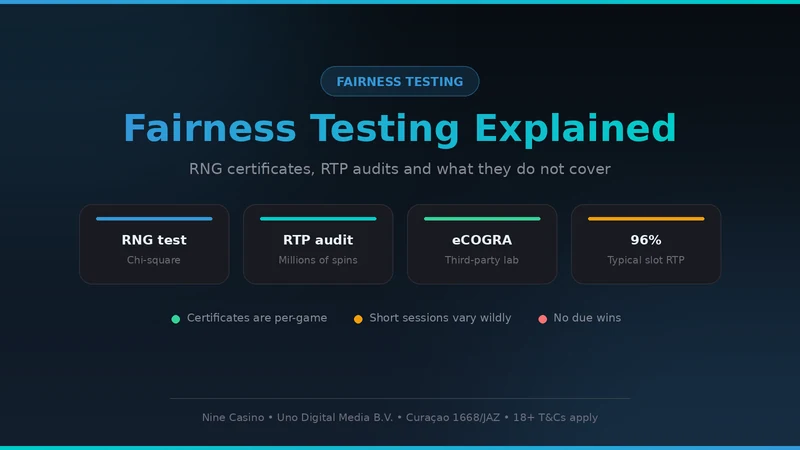
Two different tests, one certificate, and three things it never promises.
Why This Matters to You
Because it changes what you should be checking. The question "is this casino rigged?" is almost always the wrong question, and it distracts from the questions that actually decide whether you have a good or bad experience.
- The games are almost certainly straight. Pragmatic Play, Evolution, NetEnt and Play'n GO supply hundreds of operators across dozens of regulated markets. Shipping a rigged build to one Curaçao licensee would risk every one of those licences. The economics do not work.
- Which RTP build is live is a real question. Studios do ship the same title at 96.5% and at 94%. That is a legitimate configuration choice, and the difference over a year of play is substantial. The in-game paytable is where you find out.
- The operator layer is the weak point, not the games. Disputes on any casino cluster around withdrawals, verification and bonus voids, not around whether the reels were honest. That is where a regulator earns its keep.
- Certification says nothing about how you will be treated. Certified games, slow payouts and unhelpful support coexist perfectly happily. They are separate systems with separate failure modes.
Where Nine Casino sits: it runs certified games from mainstream studios under a Curaçao licence held by Uno Digital Media B.V. The game testing is the industry-standard kind. The operator-level supervision is lighter than a UK Gambling Commission licensee's, and it is not part of GAMSTOP. Both facts are true and you should weigh them together — the security and licensing page has the detail.
Who Does the Testing
Three names do most of the work in this industry. They are commercial laboratories, paid by the studios whose games they test — which is worth knowing, and is also how essentially all product certification works, from electrical safety to food standards.
eCOGRA
London-based, casino-focused. Tests RNGs and games and also audits operator practices where an operator opts in. The most visible of the three because its seal appears on site footers.
GLI
Gaming Laboratories International — the largest, working across land-based and online, and accredited to regulators worldwide. Most studios hold GLI certification for the markets that demand it.
iTech Labs
Australian, widely used for RNG and RTP certification by suppliers serving European and Asian markets. Its certificates are the ones you most often find linked from a studio's own site.
One important distinction: a lab certificate attaches to a game or a generator, not to a casino. Seeing "eCOGRA tested" against a slot tells you about the slot. A casino displaying a lab seal is claiming something broader, and it is fair to ask which specific report it refers to and when it was issued.
Certificates also age. A report from four years ago covered the build that existed four years ago. Reputable studios recertify on a schedule; the date on the certificate is as informative as the logo above it.
Myths Worth Killing
"The slot is due — it has not paid all night"
Each spin is independent. The generator has no memory of the last hour, and passing the certification tests is precisely a demonstration that it has no memory. A cold streak carries exactly zero information about the next spin. This is the gambler's fallacy and it is the most expensive idea in the building.
"The casino tightens the games when you start winning"
The operator does not run the games. They are served from the studio's own servers, identically to every other casino carrying that title. There is no per-player dial, and building one would end the studio's certification in every market it holds.
"Playing in demo mode gets you a better RTP"
Same build, same maths model, same generator. What differs is the psychology: nobody remembers the demo sessions that went badly, so demo play acquires a reputation for generosity it has not earned.
"A 96% RTP means I get 96% of my money back"
It means the game returns 96% of everything staked, across tens of millions of spins, pooled over every player. Your personal outcome over a few hundred spins is a single sample from a very wide distribution. Use the slider above — that is exactly what it is showing.
"Certified means safe to deposit"
Certification covers the game. Whether your balance is segregated, whether withdrawals are paid on time, and what happens if there is a dispute are licensing questions with entirely different answers depending on the regulator.
Checklist Before You Play
- Open the paytable and read the RTP for the build you are on.
- Check the volatility rating — it decides the shape of the session.
- Confirm the studio is one you recognise from regulated markets.
- Decide the session budget before the first spin, not during.
- Set a deposit limit in the account — it enforces where willpower does not.
- Treat the expected loss as the price of the entertainment.
The tools for the last two are set out on the responsible gaming page. Setting a deposit limit takes about forty seconds and is the single most effective thing on this entire page.
Fairness Testing FAQ
What is fairness testing in an online casino?
Independent laboratories test two separate things: that the random number generator produces statistically unpredictable, uniform output, and that a game pays back over millions of simulated rounds at the return-to-player figure its paytable claims.
Who certifies the games at Nine Casino?
Certification sits with the game studios rather than the casino. Pragmatic Play, Evolution, NetEnt, Play'n GO and the other suppliers in the lobby submit their titles to independent labs such as eCOGRA, GLI and iTech Labs, and the certificate travels with the game.
Does an RNG certificate mean I will win?
No. It means the outcomes are unpredictable and the long-run return matches the published figure. Every certified slot still carries a house edge, and the edge is the reason casinos exist.
Can a casino change a slot's RTP?
Some studios ship a title in several RTP configurations and the operator picks one. That is why the paytable inside the game you are actually playing, not a third-party database, is the number that applies to you.
Is a Curacao-licensed casino tested as strictly as a UK-licensed one?
The game-level testing is largely the same, because it is done by the studios for every market they supply. The difference is at operator level: UK Gambling Commission licensees face far heavier auditing of their own systems, funds and player protections than the Curacao regime requires.
How long does a session have to be for RTP to show up?
Far longer than anyone plays. RTP figures are measured over tens of millions of spins. Across a few hundred spins the outcome is dominated by variance, which is why a 96% slot can and regularly does return nothing at all in an evening.